
John 14:2, “In my Father’s house there are many dwelling places.”
At some point in the mid-90s I was in a convention centre in Belgium for a minor telecoms conference. I think the venue might have been Le Palais des Congrès de Liège. We were inventors. We were exhibiting a PTSN telecom switch hooked-up to a very new-fangled WWW server.
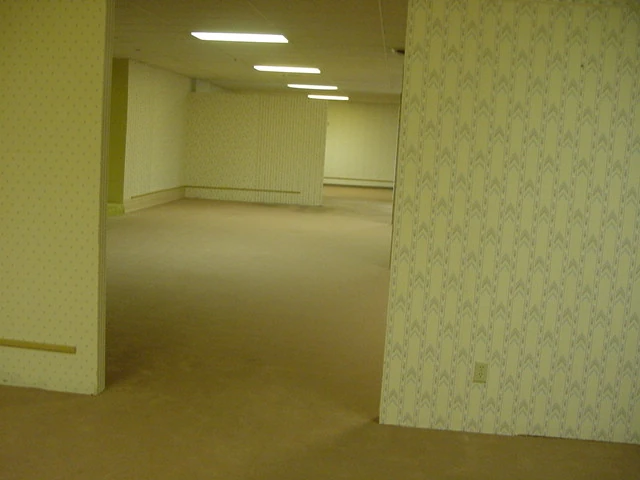
Much of the convention space was shuttered and unused. I wandered off and discovered the Backrooms – halls, corridors, rooms, toilets, theatres – beige spaces empty of people, but still showing signs of occupation. Stacks of chairs, unused tables, display boards with old posters. Always, essentially, quintessentially, one flickering fluorescent light.
It was spooky and unsettling. I was abnormally disturbed, and I made note of that. I began to take an interest in similar spaces, such as large underground car parks, and the concept of liminality.
In 1991 the 3D version of Castle Wolfenstein was released, and because of technical limitations it featured a small palette of spaces and visual elements. These were combined to create (for the time) a satisfying experience of novelty. In retrospect we can recognise how much these early games reproduced the experience of the Backrooms. Various game-level editors were created for Doom, and it was possible to create and navigate spaces that were visually congruent to the Backrooms (as the concept stabilised into a definite spatial theme).
Another idea culled from early games was clip-out and :no-clip. A developer who wanted to inspect the geometry of the game from the outside could set an option that would enable their first-person view to move through walls and other boundaries. Sometimes this would happen during gameplay, and the player would find themselves outside the game. For the gnostic, :noclip is the ultimate liberation from reality.
I forget how I discovered references to the original Backrooms creepypasta. I was probably searching the Web for various ideas around the concept of liminality. I recognised instantly the canonical image, a photo from a claimed genuine furniture warehouse in Wisconsin. I was shocked to recognise something I thought private to myself. Wow. It was clear that many people had experienced a moment of recognition.
I began to think about what I now term “low-entropy spaces” – that is, spaces that can be generated from a small number of simple rules. The Mandlebrot and Julia sets are a good example, as are spaces in early games like Wolfenstein. Crystalline structures, mazes …
Where does the horror come in? Why are the Backrooms so creepy? The prototype might be the Cretan labyrinth with the Minotaur at its heart, but consider The Willows, a famous 1907 horror short story by Algernon Blackwood. Two adventurers are canoeing down the Danube and enter a vast delta-like area with innumerable small channels, and sandbanks covered with stunted willows. As far as the eye can see: channels, sandbanks, stunted willows, an archetypal low-entropy landscape. Thin ingredients for an acclaimed horror story, but H.P. Lovecraft, master of cosmic horror, dubbed it “the finest supernatural tale in English literature”. Many of the ideas were repurposed for T. Kingfisher’s 2020 novel, The Hollow Places.
We experience much of the inherent spookiness of the Backrooms in The Shining, as Danny pedals his tricycle around the corridors of the Overlook Hotel. It’s the repetition, the elongated perspectives, the sense that the space is ontologically unsound and “we’re not in Kansas anymore”.
Low-entropy spaces are creepy. I’ve experienced something akin to The Willows in the interior of Western Australia – the land as flat as a drafting table, the road a straight line that runs from horizon to horizon, and a single low bush replicated a near-infinite number of times. Inhuman. Disturbing.
So what did I think of the 2026 movie? It follows the core ideas of the creepypasta at the beginning, but it goes off the rails. An opportunity for genuine ontological horror turns into the most generic cliche imaginable. I was hoping for something more like the Navidson House in the House of Leaves. A big fail IMO. There is another, far more disturbing film waiting to be made.